
Throughout the history of our game there has always been debate on how to evaluate players. Every single player to step foot in the batters box, or deliver a pitch from 60 feet-6 inches away has a unique background, playing history, and are physically different, yet we try to use the same stats to compare them. Over the course of 147 years, the definition of what makes a player valuable has changed.

In the early days of the American Pastime, there was a heavy emphasis on batting average. In an era where power was at a minimum, the players who could record the most hits were looked at as the best players in the game. Ty Cobb & Honus Wagner were viewed as a pair of elite players at the turn of the century, winning the batting title 12 times & 8 times respectively, but never hit more than 12 home runs in a season. In fact, Cobb won the triple crown in 1909, with 9 HR, 107 RBI, and a .377 AVG, it was a different style of play.
Power numbers would remain at a minimum until the 1920s, when for the first time a player would hit more than 25 HR in a season, when Babe Ruth hit 54 in 1920, as a member of the New York Yankees. Suddenly, there would be a power surge across baseball, with teams placing value on power numbers. Teams and fans alike would look at a spread of diagnostic metrics to evaluate players, leveraging home runs, RBIs, stolen bases, and batting averages.
Even throughout the middle of the 20th century fans and teams were fixated on batting average, Ted Williams hitting .406 in 1941 made headlines across the country, a season he would lose the MVP to Joe DiMaggio, after he hit safely in 56 consecutive games. Throughout the 1950s and 1960s, power numbers and batting average, still played a role in placing value on players, but as technology improved and information became easily available, more metrics started to emerge.
In the Baseball Abstracts written by Bill James, the first statistic to measure a player’s value in a position-adjusted runs above replacement level was mentioned, published in the 1980s. It did not gain much traction at the time, but Keith Woolner’s concept of VORP (Value Over Replacement Player) would get some more attention in Baseball Prospectus, during the 1990s.
Today the primary metric used to measure a player’s value outside of a traditional methods, is WAR (Wins Above Replacement). WAR provides a value on a player above a fictional replacement player, essentially someone who could in theory replace this player. The metric looks at how many runs above average the player is in several categories, taking into account batting, baserunning, double play avoidance, and fielding (with position adjustment). The same is done for pitchers but runs allowed below average.

Baseball statisticians were able to retroactively calculate WAR for players from past seasons. Babe Ruth owns the record for the greatest WAR in a single season, with a 14.1 WAR in 1923. Ruth also owns the record for the 2nd and 3rd greatest WAR in a season, with 12.9 WAR in 1921, and 12.6 WAR in 1927. Ruth was so far ahead of his competition when he played, both his aggregate metrics were phenomenal and were significantly better than the rest of the league.
Since the 1920s, there have been only 3 players to generate over an 11.5 WAR, as the skill gap has narrowed and the league is much more competitive. Cal Ripkin Jr had an 11.5 WAR in 1991, earning an MVP, Carl Yazstremski won the triple crown in 1967, posting the 4th highest WAR in a single season (12.4 WAR) in route to an MVP as well, and Barry Bonds did it in back to back seasons earning an MVP in each year; 2001, with an 11.9 WAR and 2002, with an 11.7 WAR.
In 2023, there were a few players that likely would have been considered most valuable in different eras of baseball. Luis Arraez led the MLB with a .354 AVG, and Matt Olson led the MLB with 54 HR & 139 RBIs, but neither finished top 3 in MVP voting. In fact the 6 finalists for MVP in each league were all within the top 8 leaders for WAR. Gerrit Cole (7.4 WAR) & Blake Snell (6.0 WAR) who each won Cy Young Awards, finished 4th and 10th respectively in WAR. Gunnar Henderson, who took home the AL ROY finished 9th with a 6.2 WAR.
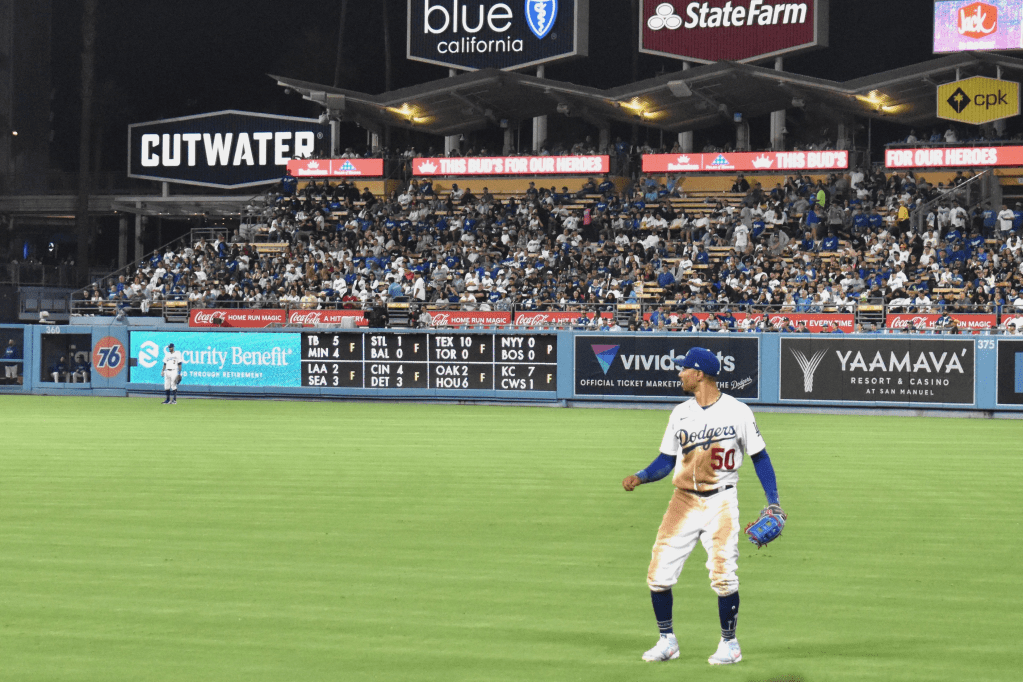
Shohei Ohtani led the MLB in WAR with a 10.0 gaining value as both a pitcher and hitter, but Mookie Betts and Ronald Acuna Jr followed up right behind him with a 8.3 WAR & 8.2 WAR as exclusively position players.
WAR is key metric in understanding which players will make an impact on a team, but it often comes at a cost. The top 10 leaders in WAR in 2023 earned a cumulative $234.7M (~$23.5M avg) and generated a 74.3 WAR in total (~7.4 avg), meaning teams were paying about $3.16M per win above replacement.
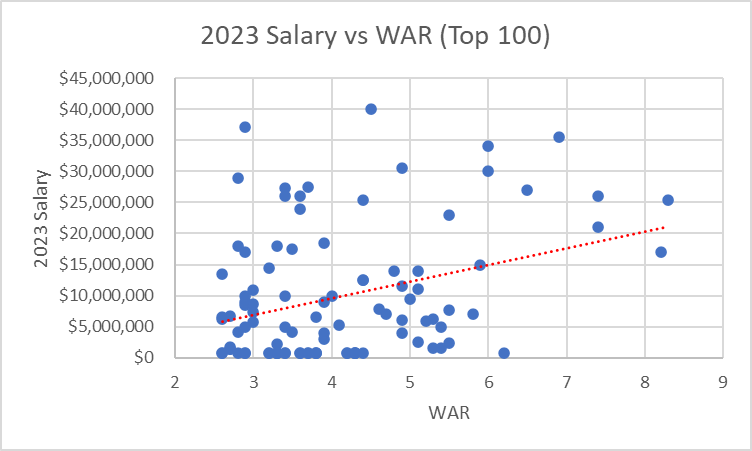
The data in the chart above skews toward lower salary’s, given the amount of players earning league minimum. Notably Gunnar Henderson, Gabriel Moreno, Adley Rutschman, Bryson Stott, Isaac Paredes, and Adolis Garcia are in the group of the most efficient players, costing between $100-200K per win above replacement. Each of these players helped their team make the playoffs. This puts an emphasis on how important young players with team control are. Being able to generate wins at a low price allows a team to use the payroll to acquire players and pay for players who can generate wins, but at a higher price tag.
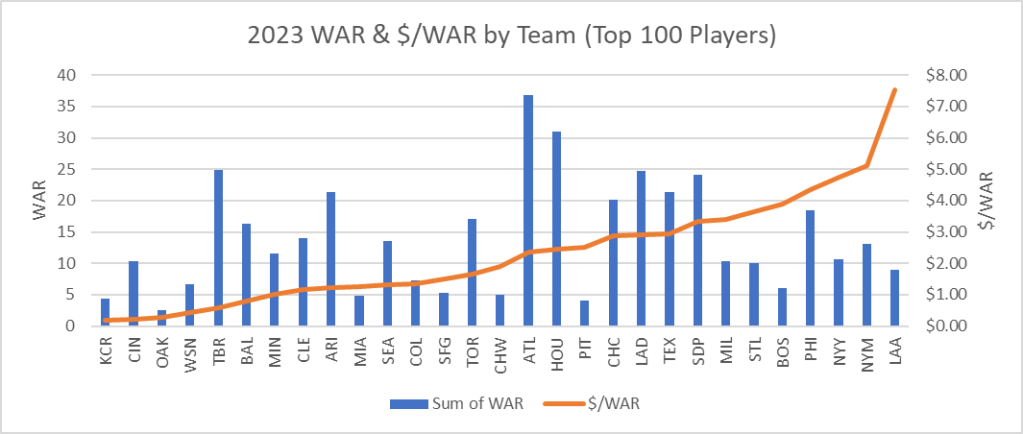
Looking at the top 100 WAR leaders in 2023, the Angels, Mets, Yankees, & Phillies were paying the most for their wins, all north of $4.0M per win above replacement. The Angels paying $37.1M to Mike Trout were not efficiently generating wins above replacement, although the former MVP generated a 2.9 WAR, leaving the team paying $7.54M per win above replacement for their most productive players in 2023. The Mets were the next least efficient team paying $5.12M per win above replacement across Francisco Lindor, Brandon Nimmo, & Pete Alonso earning a cumulative $67.1M and generating a 13.1 WAR
On the opposite end of the spectrum were 4 playoff teams in the top 10 most efficient $/WAR, the Rays, Orioles, Twins, & Diamondbacks. The Rays are performing most efficiently of the group with 6 players in the top 100 in WAR, paying them a cumulative $14.8M and generating a 24.9 WAR, for a $0.59M $/WAR. Notably the Rays traded for 4 of these players (Isaac Parades, Luke Raley, Yandy Diaz, & Randy Arozarena) and developed 2 of them (Josh Lowe & Wander Franco). The Rays are great at finding low cost talent, avoiding high salary players.

In 2023, the most valuable player financially was Gunnar Henderson, who cost just $116.7K per win above replacement. Henderson generated a 6.2 WAR earning league minimum in his rookie season at $723.2K. The Baltimore Orioles are in a great position also having Adley Rutschman under contract at league minimum in 2024, who cost just $170.7K per win above replacement in 2023. They may have the payroll flexibility after a 101 win season to buy some WAR from either trades or free agency.

 Hayes Craze Baseball
