
In the 21st century there are plenty of ways for teams to acquire players to fill up their 26-man & 40-man rosters. As time has gone on, teams are using more players throughout a season than in previous decades and there are essentially seven ways for a team to acquire players:
- Amateur Draft: The player is selected by a team and signs a contract with that team, giving the team the rights to said player.
- Amateur Free Agent: The player is either unselected or ineligible for the Amateur Draft and signs as a free agent, giving the team the rights to said player.
- Rule 5 Draft: The players signed at the age of 18 or younger and not on a 40-man roster after 5 years, or age of 19 or older and not on a 40-man roster after 4 years, are eligible to be selected by another team in the Rule 5 draft. The player selected must stay on the team’s MLB roster for 1 season.
- Purchased: A player is called up from the minor leagues without previously being on the 40-man roster, his minor league contract is purchased by the MLB team.
- Traded: Teams negotiate to exchange players, money, and other items to work out a deal, the players switch teams.
- Free Agency: When eligible, a player signs a contract with a team, with the freedom of negotiating a contract with all teams.
- Waivers: A player is released by a team, and each other team is given the opportunity to claim the player on waivers. The team that claims the player assumes the contract of the player and is placed on the 40-man roster
Given budgetary constraints, managing contracts, and success with amateur players, rosters across baseball may look very different. Is there a recipe for success or a mix of how a roster is constructed that works out better?
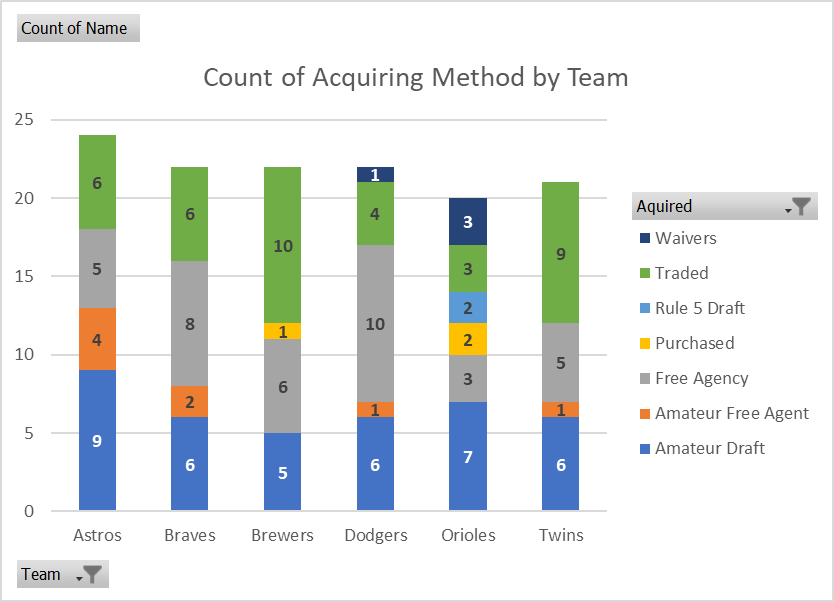
Looking back at 2023, the six division winners each beat out the other four teams in their division to make the playoffs, how did they build their rosters? Diving into the 131 players that made the greatest contributions across those six teams: 57.3% of players found their way to their team via trade or free agency, but 35.9% were home grown, via the amateur draft or signing as an amateur free agent.

The Houston Astros had the largest portion of their roster sourced through their system, with 54.2%, and the Milwaukee Brewers heavily relied on trades & free agency with 72.7% of their roster being acquired through those means.
Below is how each of the six division winners constructed their rosters. This view only looks at the players that made the greatest contributions, in terms of games played. The Dodgers & Braves we’re able to acquire more players through free agency given their bigger budgets, but the Brewers & Twins had to get creative through trades. Meanwhile the Orioles & Astros relied on their development and scouting to source players internally.
When viewing how these playoff teams sourced talent for position players, they primarily leaned on free agency and trades, with 56.1% of the team being acquired through those methods, and just 37.9% from the amateur draft and amateur free agents. Centerfield and second base were the positions to most likely find home grown talent. First base, left field, and shortstop were the top positions to find players acquired through alterative means.

When viewing pitchers, 58.5% of the six playoff teams acquired talent through trades and free agency, and just 33.8% through the amateur draft and amateur free agents. There is more volatility in pitching, and trading/signing a known commodity can help a team push for the playoffs. Starting pitchers are more likely to be home grown, whereas relievers and primary closers and overwhelmingly acquired through alternative means.

As teams enter 2024 spring training, it may be important to look at how teams were constructed. There is no recipe for winning, but a team that has more home grown talent, may fall short because they are generally younger players and potential production may vary season to season. A team built via trades and free agency, have more understanding of how their players are expected to perform.
Taking this a level deeper, it may be more beneficial to develop position players internally, and acquire pitching. Position players can move around the diamond and a team can find a position to play if they can hit, but all pitchers need to take the same mound. Again, position players only take up one spot in the lineup and on the field, so a season ending injury or long slump wont have as much of an impact as a pitcher. Teams can sign and trade for pitchers who are adverse to injury and track records of success.

 Hayes Craze Baseball