
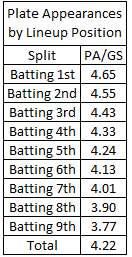
The leadoff spot is undoubtedly the most important position in the lineup. Given that the lineup turns over after the #9 hitter, the leadoff batter will receive the most opportunities to hit during a game. On average the #1 spot in the batting order will have about 4.65 plate appearances per game and then the drop off to the #2 & #3 spots in the order are 4.55 PA and 4.43 PA respectively (You can see the full breakdown of plate appearances by batting order below). Its logical to have your most effective hitter at getting on base to lead off games, so the batters behind him can drive him in, but that is not always the case.
Walks are a leadoff hitter’s best friend. The larger portion of a batter’s on-base percentage that can be attributed to walks as opposed to hits, the more valuable he’ll be to a team. Hits in the leadoff spot are often wasted, because there aren’t any batters on base to drive in. Whereas a walk is nearly never wasted, there is only one situation where a walk can drive in a run; when the bases are loaded. A batter with a larger portion of his on-base percentage attributed to hits would be more valuable in the middle or bottom of the lineup.
Take Brandon Nimmo for example: in 2022 Nimmo often lead off games for the New York Mets and had a .363 OBP in 682 plate appearances. 162 of those plate appearances resulted in a hit (63.0% singles) and 85 of the plate appearances resulted in a walk or hit by pitch.
A comparable season from another leadoff hitter may be Ichiro Suzuki for the 2008 Seattle Mariners. In 2008 Ichiro accumulated a .361 OBP in 749 plate appearances, resulting in 213 hits (84.5% singles) and 56 BB or HBP. Of course Ichiro also possessed the ability to steal bases, grossing 39 net steals in 2008, but in 236 out his 749 plate appearances he reached only first base safely as a result of his actions at the plate. His ability to hit may have been more valuable batting in the #2 or #3 spots in the order behind other players who can get on base with extra base hits or walks.
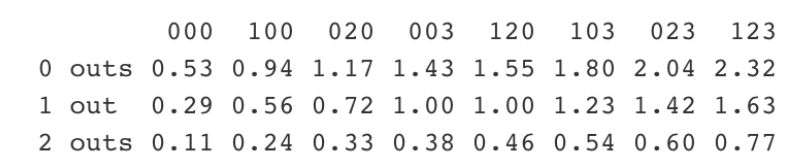
It is important for a leadoff hitter to reach base and ideally scoring position as soon as possible. Observe the run expectancy chart below, there is a significant increase in the expected number of runs with a runner on 1st and 0 outs than no runners on 0 outs. There continues to be increases in the number of runs expected as the batter reaches second base and third base safely, with outs being the only factor to decrease the number of expected runs.
It should be noted that the leadoff hitter and the first inning have an added significance to the outcome of a game. The first inning is the only inning where a manager can guarantee the batters will bat in the order intended at the start of a game and that the team that scores first wins about 67-70% of the time.
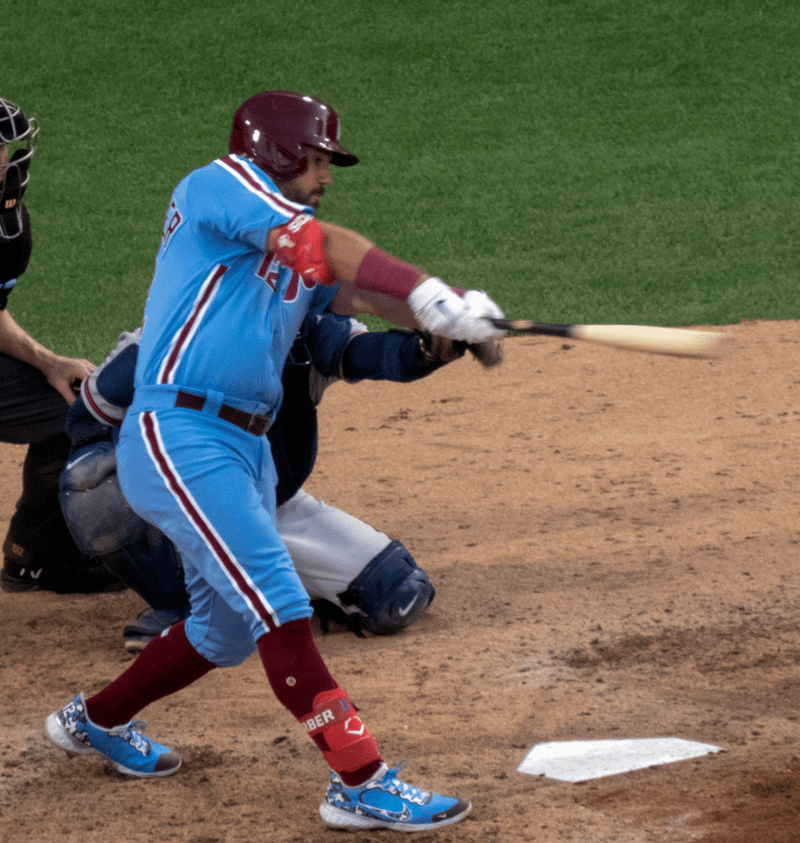
There is one other way to get on base and score from the leadoff spot: the home run. This is where Kyle Schwarber and the Phillies excelled in 2023. In the 2022 off season the Phillies acquired who they thought would be a marquee leadoff hitter when they signed Trea Turner to an 11 year $300M contract. In 2022 Turner had a .343 OBP and possessed speed that he could use on the bases, netting 24 stolen bases, but in 2023 he got off to a slow start. Starting in June of 2023 the Phillies moved away from Turner and other serviceable players and began to leverage Kyle Schwarber in the leadoff role.
In 2022 Schwarber lead the league with 200 strikeouts and had just a .323 OBP, but he excelled at getting extra base hits. Across the 699 plate appearances Schwarber had in 2022, 70 resulted in extra base hits (46 home runs), 54 resulted in singles, and he reached base via walk or HBP in 90.
When Schwarber took over the leadoff spot in June of 2023 he continued to execute his approach at the plate, hitting extra base hits, striking out often, and drawing walks. He hit 11 home runs to leadoff a game allowing the Phillies to instantly have an advantage to win the game. In those 11 games where Schwarber lead off a game with a home run the Phillies possessed an 8-3 record.
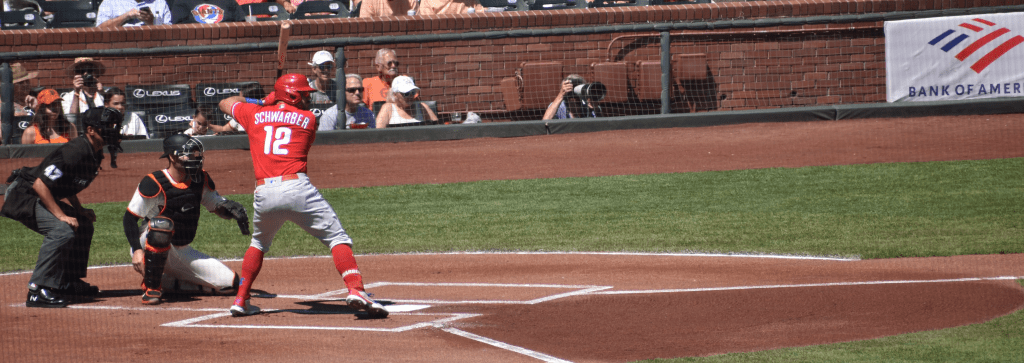
To measure the direct effect Schwarber had on these games we can look at WPA (Win Percentage Added). WPA measures the outcomes of events in a game and how much they change the probability of winning the game. In the 11 games Schwarber hit a leadoff home run his total WPA was 71% or 6.4% per game. These figures are his WPA for the entire game, but he had already made his impact in the first at bat, creating a net positive impact immediately. So a player with that much potential to produce extra base hits and draw walks works wonderfully in a lineup with batted ball potential behind him. Additionally striking out in the leadoff spot is not as detrimental as striking out with runners on base.
Schwarber continued to bat in the leadoff spot throughout the Phillies playoff run, reaching base safely 22 times in 57 plate appearances, drawing 9 walks and hitting 5 home runs. One of those home runs was a leadoff home runs against Zack Gallen in the NLCS, and the Phillies did win that game (see the win probability graph for that game below). It seems like the Phillies have found their leadoff hitter and Schwarber should continue to make an impact early and often in 2024.
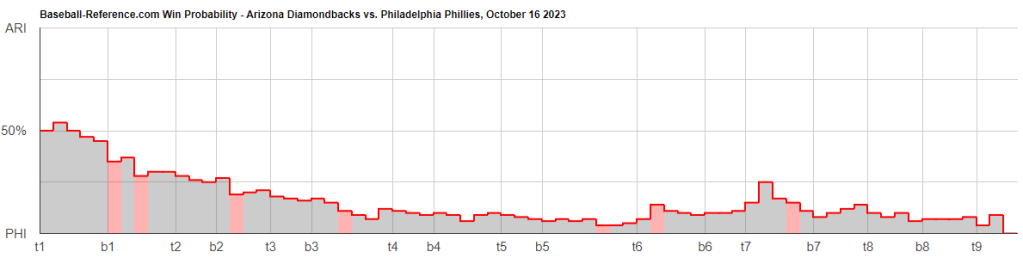
Phillies Win Probability From 55% to 65%

 Hayes Craze Baseball