

Batting Average is one of the oldest kept stats in Major League Baseball, with records available even before the creation of the league in 1876. In 1871 Levi Meyerle, a 21 year old third baseman for the Philadelphia Athletics led the National Association with a .492 batting average.
A lot has changed in our game over the course of 152 years; playing surfaces have improved, equipment has become more refined, players are more athletic, and huge strides in technology and modern analytics. The bar to be one of the best has never been higher.
In 2023 Luis Arraez of the Miami Marlins lead the MLB in batting average, with a .357 AVG, 17 points higher than Ronald Acuna Jr’s .337 AVG. Arraez has proven himself as one of the best contact hitters in the sport, leading the American League with a .316 AVG in 2022 as a member of the Minnesota Twins, and his success in 2023. Although great at generating hits and limiting strikeouts Arraez does not hit for much power, grossing 18 home runs in 291 games across his last two seasons, but he does use the entire field with nearly equal distribution across of hits to left, center, and right field. In addition to a great spray chart he finds the barrel of the bat with a medium/hard hit percentage of 90.1% in 2023.
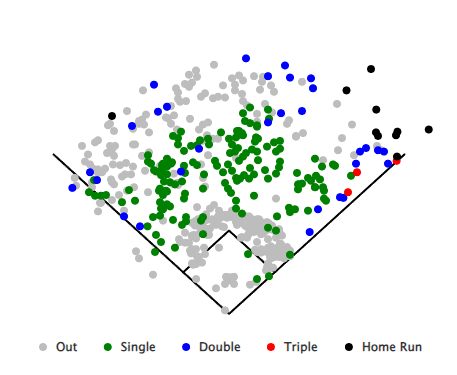
One major change in 2023 was the elimination of the shift. Previously there were no regulations on where a manager can align his players for any pitch, regularly allowing for the three infielders on the right side of the infield and often one playing in shallow right field for a left handed hitter. This put hitters who pulled the ball at a severe disadvantage. One of the rule changes in 2023 was that four infielders must be within the outer limits of the infield when the pitcher is on the rubber and infielders cannot switch sides, requiring two infielders to be on each side of second base.
The rule was added to try to increase batting average on balls in play (BABIP), giving batters incentive to make contact. In 2022 the BABIP across the league was .290, lower than .296 in 2012 and .300 in 2006. Major League Baseball recognized the trend and the also acknowledged the increase in the amount of defensive shifting happening across the league, implementing the rule to potentially bring more action to the game. They were successful in this endeavor bringing league BABIP to .297 in 2023
One of the most improved players in 2023 was Cody Bellinger, who signed a 2-Year/$25M contract with the Cubs, the deal included a mutual option for 2024, which Bellinger did not exercise and is currently a free agent. Not all of Bellinger’s improvements can be attributed to the rule change, his own personal adjustments and the Cubs coaching should receive some credit, but the change year over year is staggering.
The former MVP improved his batting average by 97 points in 2023 from .210 to .307. There was not much variation in Bellinger’s hit distribution in 2023, actually pulling the ball less often in 2023 (43.6% vs 47.2% in 2022) and making medium/hard contact at the same rate 84.4-85.5%. This leaves one to speculate the impact of the shift on Bellinger’s success.
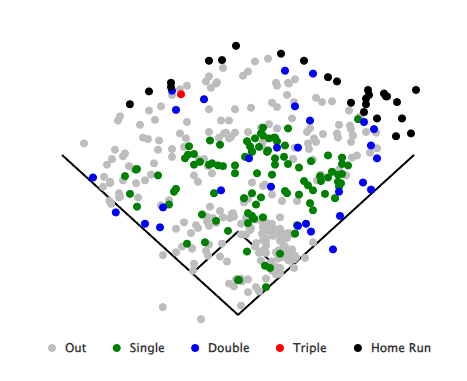
Among the players who may have benefited from the rule change the most was Carlos Santana, who split time between the Pirates & Brewers in 2023. Santana ranked 8th in batting average difference year over year and also ranked 8th in pull percentage, among qualified batters. Santana improved his batting average by 38 points in 2023, jumping from .202 to .240 while pulling the ball 49.3%. At the age of 37 years old, the rule change may have extended Santana’s career which had seen a steady decline since 2019. He is currently a free agent.
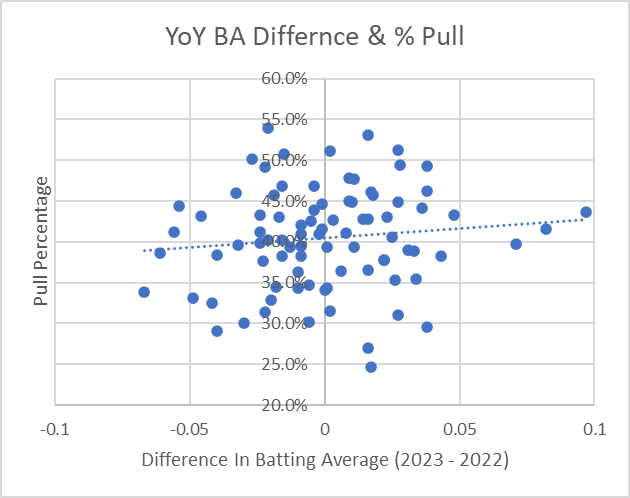
Although relatively weak correlations, there was a positive correlation between the YoY difference in batting average and pull percentage. This implies that one can attribute some success of the the most improved players to the rule change. Of course there are other factors in play, but it is difficult to ignore that what Major League Baseball set out to do may have been successful.
Baseball at a macro level is a game of fluctuation, just as quickly as a new trend catches on, another will start to counter it, and the cycle will continue. Teams originally started shifting to neutralize left handed pull hitters, and MLB intervened. With the rule change and a full season of data MLB teams will soon start to develop new strategies to get an edge again. The rule change does not apply to outfielders, so it is feasible to bring an outfielder to the infield or position them any way a manager may desire. We will see what creative ways teams rollout in 2024.